Using Your Asperger's Test Results: A Comprehensive Growth Guide for Adults
Getting your Asperger's assessment results often brings a mix of emotions - relief, clarity, and perhaps even some uncertainty. For many, it is the culmination of years of feeling "different" without knowing why. You have taken a courageous first step toward self-understanding. However, once the initial wave of emotion settles, a common question arises: What do I do with this information?
Getting a high score on an assessment or identifying with specific traits is not an ending. Instead, it is the beginning of a new chapter. This guide will show you how to transform those numbers and insights into a powerful roadmap for personal growth. By understanding your Asperger's test results, you can learn to leverage your unique neurotype. You will also develop practical strategies to navigate daily challenges.
Whether you are looking for clarity for yourself or a loved one, having a clear starting point is essential for meaningful change. Your journey of discovery starts with how you interpret the data you've received.
Understanding Your Asperger's Assessment Results
Receiving your results from an online Asperger's test is like being handed a map of a territory you have lived in your whole life but never fully charted. The first step in using these results for growth is to look at them with curiosity rather than judgment. Understanding the mechanics of the assessment helps demystify the process. It makes the data feel more useful for your daily life.
Most high-quality screenings, like those based on the AQ (Autism Spectrum Quotient) or RAADSR, focus on specific domains. These domains include social communication, sensory sensitivity, and cognitive patterns. When you review your Asperger's test results, you aren't just looking at a "pass/fail" grade. You are looking at a snapshot of how your brain processes the world around it.
Decoding Your Scores: What Numbers Really Mean
When you see your final tally, it is easy to focus only on the total number. However, the true value lies in the breakdown. A score above a certain threshold suggests that you share many traits with individuals on the autism spectrum. It is a signal that your experiences with social interaction or sensory input are clinically significant.
It is important to remember that these scores are screening tools, not formal medical diagnoses. They function as a "check engine light" for the mind. If your score is high, it validates your lived experience. It tells you that your struggles with eye contact, small talk, or loud noises are not "failings" of character. Instead, they are related to your neurological makeup. Understanding your Asperger's test results can be the first step in seeing your results as a tool for self-compassion.
Beyond the Numbers: Pattern Recognition in Your Responses
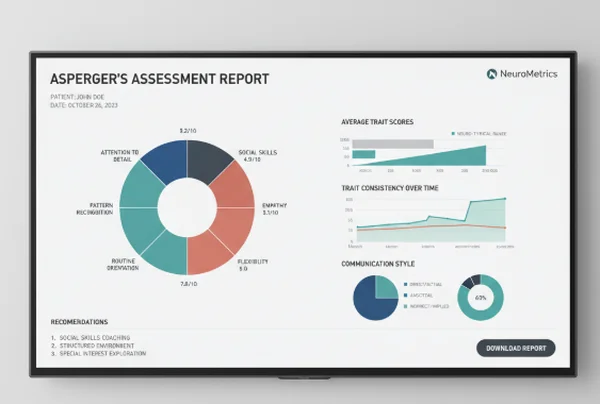
The most sophisticated part of a modern assessment is the pattern recognition it provides. While a basic score tells you "how much," a detailed analysis tells you "where" and "how." For example, you might score very high in the "Attention to Detail" category but lower in "Social Skills." This pattern tells a specific story about your cognitive style.
By looking at your specific answers, you can identify which areas of life require the most energy. Do you find transitions between tasks difficult? Are you highly sensitive to textures or lights? Recognizing these patterns helps you stop fighting against your nature and start working with it. When you access your report, look for these clusters of traits. They point directly to your biggest opportunities for growth.
Leveraging Your Asperger's Strengths for Personal Development
Many people approach an adult Asperger's test looking for what is "wrong." At Aspergerstest.me, we believe in a different perspective. We focus on neurodivergent superpowers. Being on the spectrum often brings a set of unique cognitive advantages. When properly harnessed, these traits can lead to incredible personal and professional success.
Personal growth is not about fixing a "disorder." It is about optimizing your unique gifts. When you shift your focus from "deficits" to "differences," you unlock new potential. This allows you to build a life that truly fits who you are. Reviewing your Asperger's test results with this mindset is transformative.
Identifying Your Neurodivergent Superpowers
Individuals with Asperger's traits often possess "spiky profiles." This means they have exceptional skills in specific areas. Common strengths include:
- Hyper-focus: The ability to concentrate on a complex task for hours without distraction.
- Pattern Recognition: Seeing connections and logic that others might miss.
- Integrity and Honesty: A natural tendency toward direct communication and ethical behavior.
- Specialized Knowledge: A deep, encyclopedic understanding of specific topics.
By identifying these "superpowers" through your assessment, you can begin to prioritize them. If your results show a high affinity for logic and systems, you can lean into those traits to solve problems. Identifying these strengths is a core part of the personalized analysis we provide to our users.
Building Career and Life Paths Around Your Unique Gifts
Once you know your strengths, you can audit your environment. Does your current job allow you to use your focus? Or does it force you into constant social "masking"? Masking is the exhausting process of pretending to be neurotypical to fit in. Leveraging your results means finding ways to reduce masking and increase authentic participation.
For example, if you have high sensory sensitivity but great analytical skills, you might advocate for remote work. This allows you to work in a controlled environment where your productivity can soar. Building a life around your gifts means choosing paths that reward your natural way of thinking rather than punishing it.
Developing Self-Awareness Practices for Asperger's Traits
Self-awareness is the bridge between receiving a score and making a change. Self-awareness for Asperger's involves learning to monitor your internal state in real-time. This helps you catch "sensory overload" or "social burnout" before they lead to a meltdown or total exhaustion.
Your Asperger's test results act as a guide for where to focus your self-awareness efforts. If your report highlighted social communication challenges, you can pay closer attention to how you feel during conversations. Are you getting tired? Is the noise in the room becoming painful? This data helps you make informed choices.

Mindfulness Techniques for Sensory Processing Differences
Many neurodivergent individuals find traditional mindfulness difficult. However, "sensory mindfulness" can be life-changing. This involves checking in with your five senses throughout the day. Because Asperger's often involves sensory processing issues, you may not realize you are stressed until you are already overwhelmed.
Try a "Sensory Scan" based on your test findings. If you know you are sensitive to sound, carry noise-canceling headphones. If you are sensitive to light, adjust your workspace. By staying mindful of your environment, you can manage your "sensory budget" more effectively. To better understand your sensory profile, you can take an assessment that highlights these specific traits.
Creating Personalized Sensory and Social Strategies
Growth comes from having a plan. Based on your assessment, you can create "If-Then" strategies.
- If I have a long meeting, then I will schedule 30 minutes of quiet time alone afterward.
- If I am going to a loud grocery store, then I will wear my favorite comfortable clothes to reduce tactile irritation.
These strategies aren't "excuses"; they are tools for sustainability. They allow you to participate in the world without burning out. Your Asperger's test results provide the data needed to build these customized manuals for your own life.
Setting Realistic Goals Based on Your Assessment Insights
The final step in your growth journey is setting goals. However, neurodivergent individuals often struggle with standard goal-setting. Most systems are designed for neurotypical brains. To achieve autism personal development, you need a framework that respects your energy levels and cognitive style.
Using the insights from your online Asperger's screening, you can set goals that are actually achievable. Instead of trying to "be more social," you might set a goal to "attend one interest-based meetup per month for one hour."
The SMART Framework for Neurodivergent Personal Development
The SMART (Specific, Measurable, Achievable, Relevant, Time-bound) framework works well when adapted for neurodiversity.
- Specific: Instead of "improve communication," use "practice clear 'I' statements during conflicts."
- Achievable: Ensure the goal doesn't require more "social energy" than you actually have.
- Relevant: Focus on things that actually matter to you. Avoid things you think you "should" do just to fit in.
By applying this to the traits identified in your test, you create a path of least resistance. You aren't fighting your brain; you are training it.
Creating Your Personalized Asperger's Growth Plan
Your growth plan should be a living document. It should include your strengths, your sensory "triggers," and your primary goals. Start small. Choose one insight from your detailed AI report and apply it this week.
Perhaps your report mentioned that you have a high need for routine. Your first goal could be to establish a 10-minute morning ritual that never changes. This small win builds the confidence needed for bigger changes later on. Remember, personal growth is a marathon, not a sprint. Your assessment is the starting line.
Taking an Asperger's test is a profound act of self-care. It represents a desire to stop guessing and start knowing. Whether your results confirm long-held suspicions or provide entirely new insights, they offer a foundation of truth from which you can grow.
As you reflect on your journey of self-discovery, remember that your neurotype is part of who you are, not a limitation on who you can become. By decoding your scores, leveraging your unique strengths, practicing sensory self-awareness, and setting realistic goals, you turn an assessment into an action plan.
At Aspergerstest.me, we are committed to providing you with more than just a number. Our mission is to help you understand the "why" behind your "what." If you are ready to take the next step in your journey of self-discovery, we invite you to try our free tool today. Knowledge is power, and understanding yourself is the greatest power of all.
Frequently Asked Questions About Using Asperger's Test Results
How accurate are Asperger's test results for guiding personal development?
Online screenings are highly effective at identifying the traits and patterns associated with Asperger's Syndrome. While they are not a formal medical diagnosis, they are based on clinically validated scales like the AQ and RAADSR. This makes them excellent guides for personal development. They highlight specific areas of strength and challenge that you can address immediately. For the most accurate insights, it is helpful to unlock an AI report that analyzes your specific nuances.
Can I use my Asperger's assessment results to seek professional diagnosis?
Yes, absolutely. Many healthcare professionals appreciate it when patients bring screening results to an appointment. It provides a structured starting point for the conversation. These results help you articulate your experiences more clearly to a clinician. You can use your results as a "bridge" to professional consultation.
What should I do if my test results don't match my self-perception?
It is common to feel confused if a result is lower or higher than expected. This can happen due to "masking" or simply because the autism spectrum is very broad. If your results don't seem to fit, consider retaking the test when you are in a different headspace. You might also share the questions with a trusted friend to get their perspective on your behaviors. The goal is self-discovery, so use the results as a piece of the puzzle, not the whole picture.
How often should I review and reassess my personal growth strategies based on my Asperger's traits?
Personal growth is an ongoing process. We recommend reviewing your strategies every 3 to 6 months. As you learn more about yourself and develop new coping mechanisms, your needs will change. You might find that some sensory issues become easier to manage. You might also discover new strengths you want to explore. You can always revisit your initial data to see how your self-perception evolves over time.
Are there specific career paths recommended based on Asperger's assessment results?
There is no "one-size-fits-all" career for someone with Asperger's. However, results that show high attention to detail and logic often point toward fields like software development, engineering, or research. Results that show high creative pattern recognition might lead to success in the arts or design. The key is to match your career to your specific strengths rather than a general label. Using a personalized screening tool can help you identify these specific professional advantages.