On the Spectrum Meaning: What the Phrase Really Means
The phrase "on the spectrum" usually means that a person is autistic or has traits associated with autism spectrum disorder. In everyday conversation, people often use it when they are trying to describe differences in social communication, sensory experience, routines, focus, or support needs. The phrase can be useful, but it is also easy to misunderstand. A spectrum is not a ranking from "a little autistic" to "very autistic." It is a way to describe varied patterns of traits that can look different from person to person. If you are exploring the on the spectrum meaning for yourself or someone close to you, a private traits reflection tool can help organize questions before any deeper conversation.
What Does "On the Spectrum" Mean?
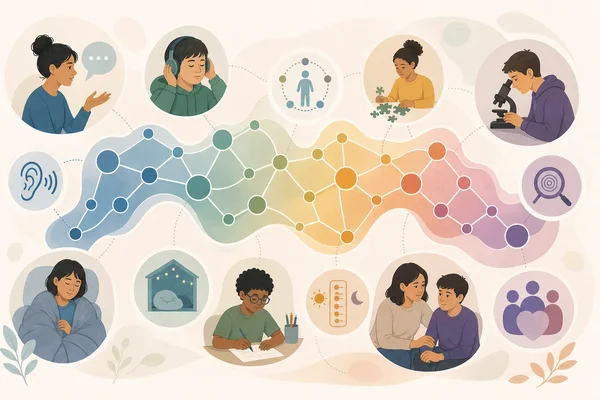
"On the spectrum" is shorthand for being on the autism spectrum. Autism spectrum disorder is a neurodevelopmental condition, which means it relates to differences in how the brain develops and processes information. The phrase may point to differences in social communication, repetitive or highly focused behaviors, sensory responses, routines, learning style, movement, or attention.
Still, the phrase should be used with care. It is not a casual label for someone who is shy, awkward, intense, literal, introverted, or highly organized. Some people have a few autism-like traits without being autistic. Some autistic people communicate easily in certain settings but struggle in others. Some need daily support, while others live independently and mainly need understanding, predictability, or accommodations.
A better way to think about the phrase is this: being on the spectrum means a person's traits fit within the broader pattern of autism, but the exact pattern is individual. It says something about how a person may experience the world; it does not tell you everything about their intelligence, empathy, personality, goals, or support needs.
Why the Spectrum Is Not a Straight Line
One common mistake is picturing the autism spectrum as a line with "mild" on one end and "severe" on the other. That picture is too simple. A person may have strong language skills but intense sensory sensitivity. Another person may communicate with fewer spoken words but have deep expertise, warmth, humor, and strong visual reasoning. Someone else may seem socially fluent at work but feel exhausted from masking after every interaction.
It is more accurate to imagine a profile with multiple dimensions. These can include:
- social communication and reading indirect cues
- sensory sensitivity to sound, light, texture, taste, or touch
- need for routine, predictability, or transition time
- focused interests and deep concentration
- repetitive movements or self-regulation habits
- executive function, planning, attention, or task switching
- daily support needs across school, work, relationships, and home
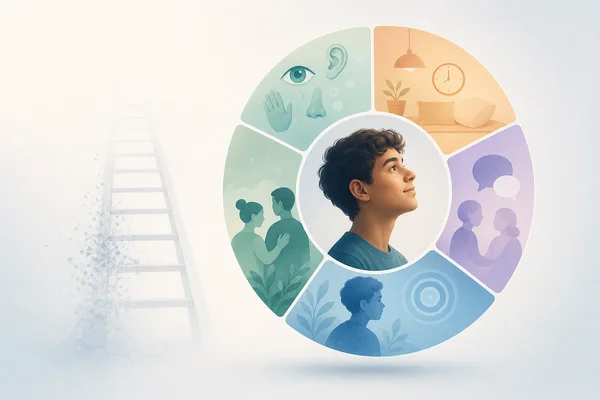
This is why "high on the spectrum" can be confusing. People often mean "more visibly autistic" or "needing more support," but those are not the same thing. A person's visible traits may change by setting, stress, sleep, masking, and available support. Respectful language focuses on the specific trait or need instead of trying to place someone on a single ladder.
Autism Meaning vs Autism Spectrum Meaning
"Autism" and "autism spectrum disorder" are often used to refer to the same broad condition. In formal clinical language, ASD is the current umbrella term. Older terms such as Asperger's syndrome, autistic disorder, and pervasive developmental disorder were once used separately, but they are now generally understood within the autism spectrum.
In everyday writing, "autism" is usually shorter and more familiar. "Autism spectrum" emphasizes variation. It reminds readers that autistic people do not all share the same strengths, challenges, communication style, or level of support. Two people can both be autistic and still have very different lives.
The word "disorder" can also feel uncomfortable to some people because many autistic people understand autism as part of identity and neurodiversity, not only a medical category. Good writing can hold both ideas at once: formal criteria matter for access to evaluation and support, while lived experience matters for dignity, language, and everyday understanding.
On the Spectrum Meaning in Adults
When people search "what does on the spectrum mean in adults," they are often trying to make sense of a long-standing pattern. Adults may look back and notice that they have always had intense interests, sensory overload, social fatigue, a strong need for routine, literal communication, or difficulty with unspoken expectations. Some adults were not formally assessed earlier because their traits were missed, masked, or interpreted as anxiety, giftedness, personality, or simple preference.
For adults, being on the spectrum does not mean a person suddenly became autistic. It usually means a lifelong pattern is being recognized more clearly. That recognition can be emotional: some people feel relief, some feel grief about missed support, and some feel uncertain about language. All of those reactions can be valid.
Self-reflection can be a first step, especially when it is private and low pressure. An autism traits self-screening resource may help adults notice patterns in communication, sensory experiences, routines, and daily-life impact. It should not replace a formal clinical evaluation, but it can help someone prepare clearer notes if they decide to speak with a qualified professional.

Kids on the Spectrum Meaning
For children, "on the spectrum" usually means that caregivers, educators, or clinicians have noticed autism-related developmental patterns. These may involve social communication, play, language, sensory responses, repetitive behaviors, restricted interests, routines, or differences in learning and movement. Some children show signs very early. Others become more noticeable when school, friendships, or transitions become more demanding.
It is important not to reduce a child to a label. The most helpful question is not "How autistic are they?" but "What helps this child communicate, feel safe, learn, rest, and participate?" A child may need visual schedules, sensory breaks, direct language, support with transitions, speech-language help, occupational therapy, school accommodations, or simply adults who understand that behavior is often communication.
Parents and caregivers do not need to have every answer before asking for support. If a child's development, communication, sensory reactions, or daily functioning raises concern, a pediatrician, school team, or qualified developmental specialist can guide the next step. Early support can be useful, but support is also valuable at older ages.
Does Having ADHD Mean You're on the Spectrum?
No. ADHD does not automatically mean someone is on the autism spectrum. ADHD and autism are different neurodevelopmental conditions, though they can overlap and can occur together. Both can involve attention differences, executive function challenges, restlessness, sensory sensitivity, emotional intensity, or difficulty with transitions. That overlap is one reason people sometimes confuse them.
A simple comparison can help:
- ADHD often centers on attention regulation, impulsivity, restlessness, time management, and task initiation.
- Autism often centers on social communication differences, sensory processing, routines, repetitive patterns, focused interests, and support needs.
- A person can have ADHD, autism, both, or neither.
Because overlap is common, internet descriptions alone can be misleading. If the question affects school support, work accommodations, medication decisions, or mental health care, it is better to discuss the full pattern with a qualified professional rather than relying on a single phrase.
What "On the Spectrum" Means in Slang
In slang, "on the spectrum" is sometimes used casually to describe someone who seems socially unusual, literal, blunt, obsessive, awkward, or highly focused. That use can be harmful when it becomes a joke, insult, or shortcut for judging someone's personality. It can also spread inaccurate ideas about autism.
Respectful use depends on context and consent. It is usually fine to use the phrase for yourself if it fits your identity or experience. It may be fine to use it for someone who has openly shared that language. It is not respectful to speculate about a coworker, classmate, celebrity, or family member as entertainment.
If you are not sure what language someone prefers, use person-first or identity-first wording based on their preference. Many people say "autistic person." Some prefer "person with autism." Some use "on the spectrum." The best choice is the one the person chooses for themselves.
A Practical Way to Understand the Phrase
If the on the spectrum meaning feels personal, try turning the phrase into specific observations. This keeps reflection grounded and reduces the urge to self-label too quickly.
Ask yourself:
- Which situations feel confusing, draining, or unusually intense?
- Are sensory experiences such as sound, light, clothing, food texture, or crowds a major factor?
- Do routines, plans, or transition time affect your day more than other people seem to expect?
- Do you have focused interests that feel central to learning, joy, or calm?
- Do social rules feel indirect, inconsistent, or tiring to decode?
- What supports already help you function better?
These questions do not settle whether someone is autistic. They help create a clearer picture. That picture can support self-understanding, a conversation with a trusted person, or preparation for formal assessment if that feels appropriate.
Exploring the Meaning Without Pressure
Learning what "on the spectrum" means should make the topic clearer, not more frightening. Autism is not a character flaw, a single personality type, or a measure of worth. It is a broad pattern of neurodevelopmental differences that can involve both strengths and challenges. The most useful next step is usually gentle: notice patterns, learn respectful language, and consider what support would make daily life easier.
For a private starting point, you can use structured traits exploration to reflect on communication, routines, sensory experiences, and daily-life impact. Treat the result as educational information, not a final answer. If the question is affecting health, school, work, relationships, or safety, consider bringing your notes to a licensed clinician, therapist, school professional, or other qualified support person.

FAQ
What does it mean if someone is on the spectrum?
It usually means the person is autistic or has autism-related traits that fit within the autism spectrum. The phrase does not explain the person's full personality, intelligence, empathy, or support needs. It is best understood as a starting point for respectful curiosity, not as a complete description.
What does "on the spectrum" mean in adults?
In adults, it usually refers to lifelong autism-related traits that may now be easier to recognize. These can involve sensory sensitivity, social fatigue, direct communication, routines, focused interests, masking, or support needs. Some adults seek a formal clinical evaluation, while others begin with private reflection and education.
What does "on the spectrum" mean in slang?
In slang, people may use it casually to mean socially awkward, unusually focused, literal, or different. That use can be inaccurate or disrespectful if it is used as a joke or insult. It is better to use the phrase only for yourself or for someone who has chosen that language.
What is the difference between autism and autism spectrum disorder?
Autism is the common shorthand. Autism spectrum disorder, or ASD, is the formal umbrella term used in many clinical settings. The word "spectrum" highlights that autistic people can have different combinations of traits, strengths, challenges, and support needs.
What are three common areas of autism traits?
A simple way to group common traits is social communication differences, restricted or repetitive patterns, and sensory processing differences. Not every person shows these in the same way. Some traits may be visible in childhood, while others become clearer in adulthood or during stressful transitions.
Does having ADHD mean you're on the spectrum?
No. ADHD and autism are different conditions, although they can overlap and can occur together. ADHD often involves attention regulation, impulsivity, and executive function. Autism more often involves social communication differences, sensory processing, routines, repetitive patterns, and focused interests.
What billionaire has autism?
Elon Musk has publicly said he has Asperger's, an older term now generally included within the autism spectrum. Public examples should be handled carefully. A famous person's disclosure does not define autism, and it is not appropriate to speculate about people who have not shared that information themselves.