Is Autism a Psychiatric Disorder? How to Understand Autism, Mental Health, and Support
If you are asking "is autism a psychiatric disorder," you are probably trying to sort out several overlapping words: psychiatric, neurological, mental health, developmental, and autism spectrum disorder. The simplest answer is that autism is usually described as a neurodevelopmental condition, not a mental illness in the everyday sense. At the same time, autism is included in psychiatric classification manuals and may be evaluated by mental health professionals. That can make the wording feel confusing. For people exploring traits in themselves or someone they care about, a private autism traits self-screening can be a gentle starting point for reflection, but it should sit alongside professional guidance when questions are serious, complex, or affecting daily life.

The Short Answer: Autism Is Neurodevelopmental, Not a Mental Illness
Autism spectrum disorder is commonly classified as a neurodevelopmental condition. That means it relates to differences in early brain development, communication, social interaction, sensory processing, routines, attention patterns, and ways of learning from the world. These differences are not the same thing as depression, anxiety, psychosis, or a temporary emotional state.
The phrase "psychiatric disorder" can still appear because psychiatry includes more than mood or emotional distress. Psychiatric manuals also organize developmental and behavioral conditions. Autism appears in that clinical classification system so clinicians, schools, researchers, and services can use shared language.
So the most accurate plain-English answer is: autism is not best understood as a mental illness, but it can fall within psychiatric classification because psychiatry covers neurodevelopmental conditions too. That distinction matters because it reduces stigma and helps people seek the right kind of support.
Why Autism Appears in Psychiatric Manuals
Autism is included in major psychiatric classification systems because these systems are not only lists of mental illnesses. They are broad clinical maps used to describe patterns of development, behavior, communication, emotion, and functioning. ADHD, intellectual developmental disorder, learning disorders, anxiety disorders, schizophrenia, and autism may all appear in related systems, even though they are not the same type of condition.
This is where many search questions come from. Schizophrenia is generally discussed as a psychiatric disorder involving psychosis. Anxiety is a psychiatric condition when it reaches a clinically significant pattern. ADHD is commonly listed as a neurodevelopmental condition and can also be part of psychiatric care. Autism sits closer to ADHD than to anxiety or schizophrenia because both autism and ADHD involve development and brain-based patterns that often begin early in life.
For readers comparing traits, structured Asperger and autism traits exploration can help organize observations before a conversation with a qualified professional. It cannot replace an evaluation, but it can give you clearer language for patterns you want to understand.
Autism, Neurology, and Mental Health Are Related but Not Identical
People often ask whether autism is neurological or psychiatric as if only one label can be true. In practice, the categories overlap but do different jobs.
Neurological language points to the brain and nervous system. It is useful when discussing sensory processing, motor coordination, sleep, attention, executive function, and developmental differences.
Psychiatric language points to clinical classification, emotional health, behavior, and support planning. It is useful when discussing anxiety, depression, burnout, ADHD, or whether someone may benefit from therapy, medication for a co-occurring condition, or a formal autism evaluation.
Mental health language points to well-being. An autistic person can have good mental health, poor mental health, or changing mental health across different seasons of life. Autism itself is not a mood state. But autistic people can experience anxiety, depression, trauma responses, sleep problems, eating difficulties, or stress from years of masking and misunderstanding.
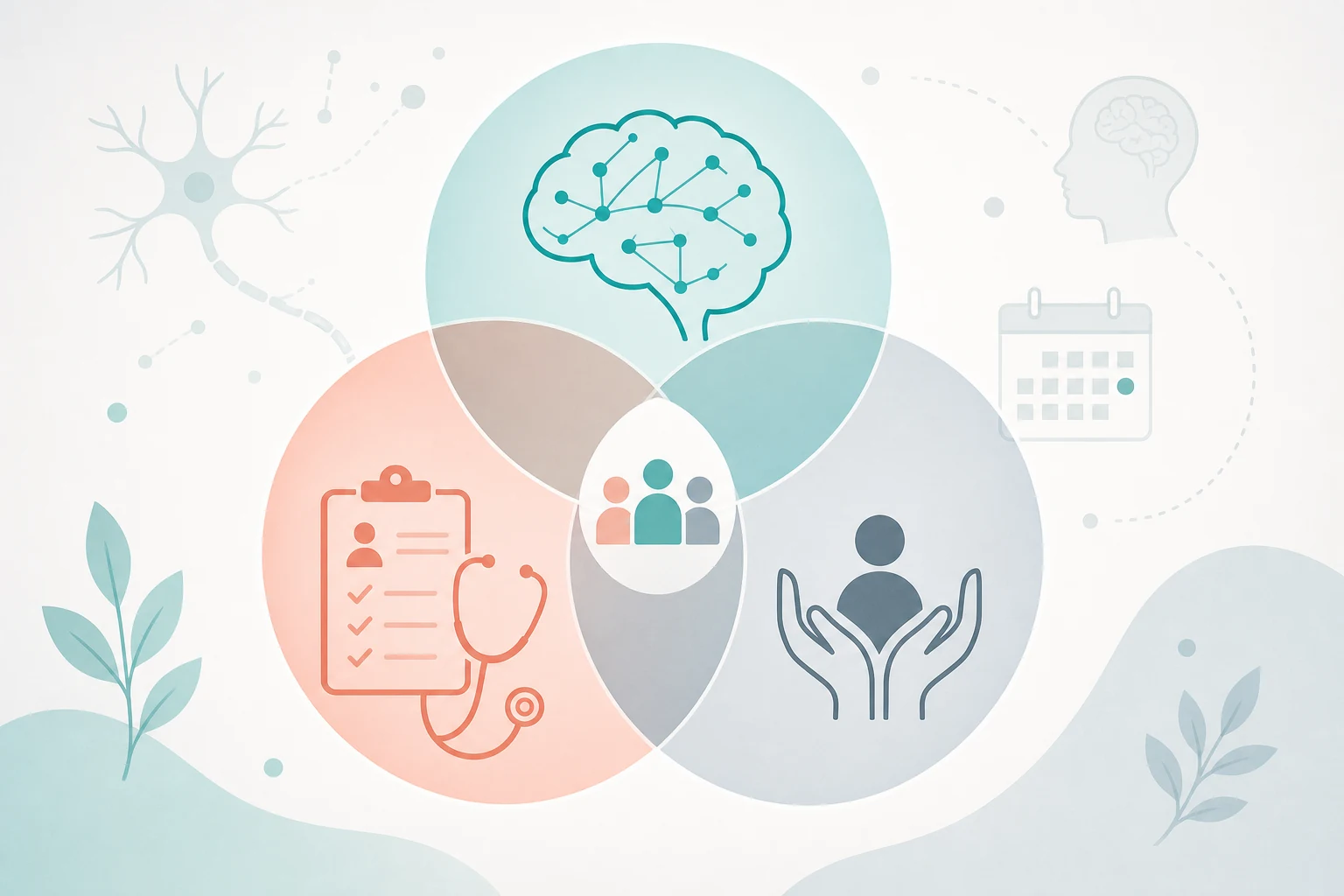
Common Co-Occurring Mental Health Conditions in Autism
Autism and mental health comorbidity is a key reason the terminology gets tangled. Many autistic adults and children also experience mental health conditions, but those conditions are not the same as autism.
Anxiety is common because unpredictable environments, sensory overload, social uncertainty, bullying, or pressure to mask can create chronic stress. Depression may appear when someone feels isolated, misunderstood, exhausted, or unsupported. ADHD can co-occur and may affect attention, impulse control, planning, and energy regulation. Sleep difficulties, eating differences, obsessive-compulsive symptoms, and trauma-related stress can also be relevant for some people.
This is why "autism and mental health treatment" should usually mean support for the whole person, not an attempt to erase autistic traits. Helpful support may include sensory accommodations, communication adjustments, predictable routines, therapy adapted for autistic thinking styles, medication for a separate condition when appropriate, coaching around executive function, family education, school support, or workplace changes.
A useful question is not "How do we make autism disappear?" A better question is "Which parts of life are causing distress, and what supports would reduce that distress while respecting the person's neurotype?"
High-Functioning Autism and Adult Mental Health
"High-functioning autism" is still a common search phrase, but it can hide important needs. Someone may speak fluently, hold a job, study well, or appear socially capable while privately spending enormous energy on masking, sensory control, transitions, or recovery after social demands. Labels based only on outward functioning can miss anxiety, burnout, executive function struggles, or the effort needed to appear fine.
Autism and mental health in adults often becomes clearer when life demands increase. College, work, parenting, relationships, moving homes, grief, conflict, or chronic sensory stress can expose needs that were manageable in a more structured environment. Some adults begin asking about autism after years of being treated only for anxiety or depression, because those supports helped part of the picture but not the whole pattern.
An adult-friendly approach looks for both traits and context. What settings drain energy? What sensory inputs feel intense? Which conversations are hardest to decode? What routines protect stability? What strengths appear when the environment fits better? These questions make the conversation more practical and less label-focused.
Autism Burnout: What It Means and Why Classification Matters
Autistic burnout is often described as a deep, long-lasting exhaustion that can follow sustained masking, sensory stress, social overload, or demands that exceed a person's capacity. It may involve reduced tolerance for input, loss of skills that were usually accessible, shutdowns, increased need for solitude, or difficulty completing everyday tasks.
Burnout is not laziness. It is also not proof that autism suddenly appeared in adulthood. For many people, burnout is a sign that coping systems have been stretched too far for too long.
Classification matters here because a purely psychiatric lens may focus only on anxiety or depression, while a purely neurological lens may miss emotional strain. A balanced view asks how autistic traits, environment, mental health, sleep, workload, sensory load, and support systems interact. That wider view can lead to more humane next steps: reducing overload, simplifying demands, rebuilding routines, adapting communication, and seeking professional support when symptoms feel intense or unsafe.

When a Psychiatrist, Psychologist, or Doctor May Be Involved
Different professionals can be involved in autism-related care. A psychologist may complete developmental, cognitive, behavioral, or adaptive assessments. A psychiatrist may evaluate autism, assess co-occurring mental health conditions, and consider medication when anxiety, depression, ADHD, sleep problems, or another condition needs medical management. A primary care clinician may help with referrals and broader health questions. Speech-language therapists, occupational therapists, counselors, and educators may also support communication, sensory needs, daily routines, and school or workplace planning.
The exact pathway depends on age, location, insurance, school systems, and the reason for seeking help. A child may enter through school concerns, developmental services, or pediatric care. An adult may enter through therapy, psychiatry, workplace stress, relationship strain, or self-reflection after reading about autism spectrum disorder.
If there are concerns about self-harm, severe depression, major sleep loss, eating restriction, substance use, psychosis, aggression, or sudden loss of daily functioning, it is wise to seek timely professional or emergency support. Autism-friendly care should respect neurodiversity while still taking distress seriously.
A Practical Way to Think About Autism and Mental Health
The most useful answer to "is autism a psychiatric disorder" is not a single label. It is a layered understanding:
- Autism is best described as a neurodevelopmental condition.
- It appears in psychiatric classification because those systems include developmental and behavioral conditions.
- Autism is not the same as a mental illness, but autistic people can have mental health conditions.
- Support works best when it respects autistic traits and addresses distress, barriers, and co-occurring needs.
If you are exploring your own traits, an educational AQ-style reflection tool may help you notice patterns in social communication, routines, sensory experiences, and daily life. Use the results as a reflection aid, not a final answer. The next step may be reading more, tracking examples from real life, discussing concerns with someone you trust, or seeking a professional evaluation if the question is affecting school, work, relationships, safety, or well-being.
FAQ
Is autism a neurological or psychiatric disorder?
Autism is most often described as a neurodevelopmental condition. It has neurological aspects because it involves brain development, sensory processing, communication, and learning patterns. It may also appear in psychiatric classification systems, so both contexts can be relevant.
Does autism come under psychiatry?
Autism can come under psychiatry when a psychiatrist is involved in formal evaluation, care planning, or treatment of co-occurring mental health conditions. That does not mean autism is simply a mental illness. It means psychiatry is one professional field that may help assess and support neurodevelopmental conditions.
Can psychiatrists formally evaluate autism?
Some psychiatrists can evaluate autism, especially when they have experience with neurodevelopmental conditions. Psychologists, developmental specialists, pediatricians, and multidisciplinary teams may also be involved. The best professional depends on age, local systems, and the complexity of the situation.
Is autism a mental illness or neurological disorder?
Autism is not usually described as a mental illness. It is better understood as a neurodevelopmental condition with neurological, behavioral, social, sensory, and communication dimensions. Mental health conditions such as anxiety or depression can co-occur with autism, but they are separate from autism itself.
Is anxiety a psychiatric condition?
Anxiety can be a psychiatric condition when it becomes persistent, intense, and disruptive enough to meet clinical criteria. Everyday worry is different from an anxiety disorder. In autistic people, anxiety may be connected to sensory stress, uncertainty, social demands, trauma, or lack of support.
Is ADHD a psychiatric diagnosis?
ADHD is commonly classified as a neurodevelopmental condition, and it is also part of psychiatric and mental health care systems. Like autism, ADHD can involve developmental patterns and may be evaluated or treated by professionals who work in psychiatry, psychology, pediatrics, or primary care.
Is schizophrenia a psychiatric disorder?
Schizophrenia is generally considered a psychiatric disorder involving psychosis, such as hallucinations, delusions, disorganized thinking, or major changes in functioning. It is different from autism, though a careful professional evaluation may be needed when symptoms overlap or when a person has more than one condition.
What is autistic burnout?
Autistic burnout is often described as intense exhaustion after prolonged masking, overload, stress, or demands that exceed capacity. It may involve reduced functioning, stronger sensory sensitivity, shutdowns, and a need for significant recovery. Support usually focuses on reducing demands, improving accommodations, and addressing mental health strain.