Is Autism a Disease? A Clear Guide to the Facts
Autism is not a disease in the everyday sense of an infection, illness, or something that spreads from person to person. It is best understood as a lifelong neurodevelopmental condition that affects communication, social interaction, sensory processing, learning, attention, routines, and behavior in different ways. That distinction matters because the words people use can shape fear, stigma, and the kind of support an autistic person receives. If you are exploring traits for yourself or someone you care about, an educational autism traits self-reflection tool can help you organize observations without turning a personal question into a label.
The Short Answer: Autism Is Not a Disease
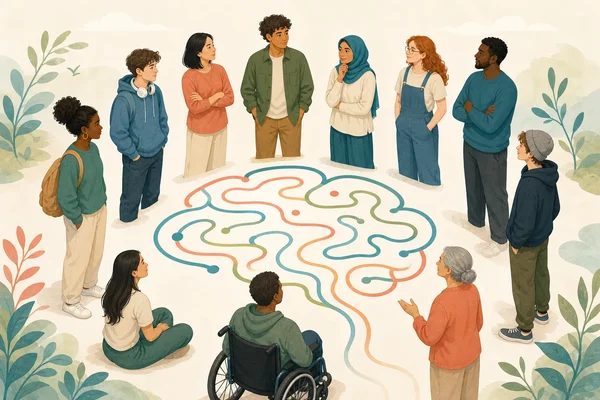
The clearest answer to "is autism a disease" is no. A disease usually suggests a pathologic process with a specific onset, a route of spread, a treatment target, or a goal of removal. Autism does not work that way. Autistic people are born with differences in brain development, and those differences can influence how they experience language, relationships, sensory input, change, focused interests, and daily expectations.
Autism is also not contagious. You cannot catch it from another person, pass it through casual contact, or develop it because you spent time around autistic people. It is not a character flaw, a parenting outcome, or a sign that someone lacks emotion or intelligence. Those ideas persist because public language about autism has often been sloppy, fearful, or based on outdated assumptions.
The more accurate phrase is autism spectrum disorder, often shortened to ASD. Some people prefer "autism" or "autistic" because they see it as part of identity. Others use "ASD" in medical, educational, or service settings. The important point is that autism describes a developmental pattern, not a disease that makes someone less whole.
Disease, Disorder, Disability, or Condition?
The terms can feel confusing because different systems use different language. Autism is often called a neurodevelopmental disorder in clinical and research settings. That does not mean it is a disease. It means the traits are related to early brain development and can affect functioning enough that a person may need support.
Autism can also be a disability. For some people, sensory overwhelm, communication barriers, executive function demands, or social expectations create real limitations at school, work, home, or in public spaces. Disability language can be useful because it opens the door to accommodations, services, legal protections, and practical support. It should not be used to reduce a person to deficits.
"Condition" is a broad, neutral word. It can be helpful when you want to avoid loaded language while still acknowledging that autism can have serious daily effects. Many autistic people and families use a mix of terms depending on the context.
Here is a practical way to separate them:
- Disease: usually implies illness, infection, or a process to eliminate. This is not the best fit for autism.
- Disorder: the formal clinical category many systems use for autism spectrum disorder.
- Disability: a support-focused term when autistic traits limit access, participation, or daily functioning.
- Condition or neurotype: broader words that often feel less stigmatizing in everyday conversation.

Why People Think Autism Is a Disease
People often call autism a disease because they are trying to describe real challenges. A child may have delayed language, intense distress during change, sleep problems, feeding issues, or sensory overload. An adult may struggle with workplace expectations, social exhaustion, burnout, or relationships. Those challenges are serious, and support can matter deeply.
The mistake is turning support needs into disease language. When autism is framed only as damage, burden, or tragedy, people may overlook strengths, identity, access needs, and the fact that autistic people vary widely. Some need lifelong daily support. Others live independently but still benefit from accommodations, clearer communication, or better sensory environments. Many are somewhere in between.
Another reason is that autism appears in health care and mental health systems. Insurance forms, school reports, and clinical manuals use categories that sound medical. That can make "disease" feel like the obvious word even when it is not accurate. A better approach is to use precise language: autism is a neurodevelopmental condition, autistic people can have support needs, and some autistic people also have separate physical or mental health conditions.
If you are trying to make sense of traits before a formal evaluation, a private Asperger's and autism traits screener may give you language for patterns to discuss later, while still respecting that online tools are educational rather than clinical.
Is Autism a Mental Disorder?
Autism is listed in mental and developmental health classification systems, but it is not the same thing as a mental illness such as depression or an anxiety disorder. Autism is neurodevelopmental: signs generally begin early in life, even if they are not recognized until later childhood, adolescence, or adulthood.
This distinction matters because autistic people can also experience mental health conditions. Anxiety, depression, ADHD, sleep problems, eating difficulties, and other concerns can occur alongside autism. Those co-occurring concerns deserve attention in their own right. They should not be treated as proof that autism itself is a mental health disease.
A useful question is not "Is autism mental or physical?" but "What support does this person need to communicate, learn, regulate sensory input, participate, and feel understood?" That question leads to more humane and practical decisions.
The Main Signs People Usually Mean by Autism Symptoms
Autism looks different from person to person, so no short list can capture every experience. Still, most descriptions cluster around three broad areas.
First, autism can affect social communication and interaction. This may include difficulty reading indirect cues, different eye contact patterns, literal interpretation, trouble with back-and-forth conversation, delayed speech, very detailed speech about focused interests, or needing more recovery time after social contact.
Second, autism can involve restricted or repetitive patterns of behavior, interests, or routines. A person may rely on predictable routines, repeat movements or phrases, become deeply absorbed in a narrow topic, or feel distressed when plans change suddenly. These patterns are not automatically bad; they may also bring comfort, skill, focus, and joy.
Third, many autistic people have sensory differences. Light, sound, smell, texture, taste, pain, temperature, or body awareness may feel more intense, less noticeable, or simply different. Sensory needs can affect school, work, meals, clothing, hygiene, sleep, travel, and relationships.
These signs are not a checklist for self-labeling with certainty. Many people without autism share some traits. What matters is the full developmental pattern, the level of daily impact, and whether supports would improve quality of life.

What Causes Autism?
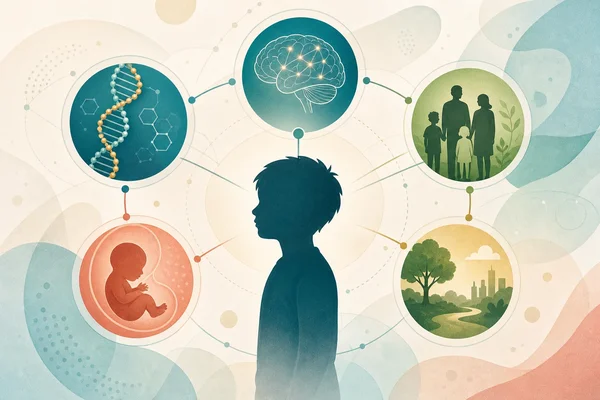
There is no single known cause of autism. Current evidence points to a complex mix of genetic, biological, and environmental factors. Family history can matter. Certain genetic or chromosomal conditions are associated with a higher likelihood of autism. Differences in early brain development also appear to be part of the picture.
When people ask "what are the three main causes of autism," the safer answer is three broad categories rather than three simple causes:
- Genetic contribution, including inherited and non-inherited genetic changes.
- Biological development, including differences in how the brain develops and communicates.
- Risk-related environmental factors, including some pregnancy, birth, and early-life factors that researchers continue to study.
This does not mean a parent caused autism through ordinary choices. It also does not mean one exposure explains most autism. Simple blame stories are usually misleading. Autism is not caused by parenting style, personal weakness, or being around autistic people.
What About Pregnancy, Vaccines, and Prevention Claims?
Questions about pregnancy are common and often emotionally loaded. Research has explored links between autism likelihood and factors such as certain genetic conditions, family history, older parental age, premature birth, birth complications, and some prenatal or environmental exposures. These are risk factors, not a simple recipe.
That difference is important. A risk factor can be associated with a higher likelihood without being the only cause or being present in every autistic person. Many autistic people have no obvious single risk factor. Many people with a risk factor are not autistic.
Vaccines are often pulled into this discussion because of old and persistent misinformation. Major medical and public health bodies have repeatedly rejected the claim that vaccines are a proven cause of autism. Keeping that distinction clear protects both public health and autistic dignity.
Claims that autism is "preventable" should be treated with caution. Some pregnancy and child health steps are sensible for many reasons, but autism should not be framed as a parental failure or a condition that could reliably have been avoided. The more useful goal is early understanding, supportive environments, and access to services when needed.
Is Autism Common?
Autism is common enough that most communities, schools, workplaces, and families include autistic people, whether everyone realizes it or not. Reported rates have increased over time in many places. That does not automatically prove that autism itself has suddenly become more common in a simple biological sense.
Several factors can affect reported rates: broader awareness, changes in criteria, better screening, improved access to evaluations, more school and service documentation, and greater recognition of people who were missed in the past. Girls, women, people of color, adults, and people with subtle or masked traits have historically been overlooked more often.
The practical takeaway is simple: autism is not rare enough to treat as unusual, and it is not uniform enough to treat with stereotypes. People need accurate information, respectful language, and support matched to their own life.
Where Asperger's Fits Today
Many people still search for Asperger's because they relate to descriptions of autism without intellectual disability or with fluent speech, intense interests, social confusion, sensory differences, and a lifetime of feeling out of step. In many current systems, Asperger's syndrome is no longer treated as a separate category; it is generally understood within the autism spectrum.
That does not make the word meaningless. Some adults received that label years ago. Others use it because it helped them find language before they encountered broader autism resources. Still, the phrase "Asperger's disease" is not accurate. Asperger's is better understood as an older label connected to autism spectrum traits, not a disease.
For a site like AspergersTest.me, this distinction matters. The goal is not to push a label onto someone. It is to help a person notice patterns, understand traits, and decide whether further support, accommodations, or a professional conversation would be useful.
A Respectful Next Step If You Are Wondering About Traits
If the question "is autism a disease" feels personal, pause before forcing a yes-or-no label onto yourself or someone else. A better next step is to write down real-life patterns: communication differences, sensory triggers, routines, burnout, focused interests, school or work barriers, relationship misunderstandings, and strengths that show up alongside challenges.
You can also ask what kind of support would help, even before any formal process: clearer instructions, quieter environments, predictable schedules, written communication, sensory tools, flexible work routines, or more direct social expectations. Support does not need to wait for perfect wording.
For private reflection, an educational online autism traits questionnaire can help structure what you are noticing. Use it as a starting point, not a final answer. If traits are affecting safety, learning, work, relationships, or mental health, consider discussing your observations with a qualified professional who understands autism across ages and presentations.
FAQ
Is autism a disease or a disorder?
Autism is not a disease in the usual sense. The formal term autism spectrum disorder is used in many clinical and educational settings, but the condition is neurodevelopmental rather than contagious, degenerative, or something that should be treated as personal failure.
Is autism a disability?
Autism can be a disability when communication, sensory, social, learning, or daily-living differences limit access or participation. Some autistic people need extensive support, while others need targeted accommodations. Disability language can be useful when it helps people receive practical support and rights.
Is autism a genetic disease?
Autism is not one single genetic disease. Genetics can play an important role, and some genetic or chromosomal conditions are linked with a higher likelihood of autism. Still, autism is usually understood as multifactorial rather than caused by one gene in every person.
What is 90% of autism caused by?
No careful answer should claim that 90% of autism is caused by one simple factor. Some discussions use high percentages when talking about genetic contribution, but that does not mean one gene, one exposure, or one parent action explains autism. The causes are complex and still being studied.
Is autism contagious, autoimmune, or degenerative?
Autism is not contagious. It is not usually classified as an autoimmune disease, and it is not a degenerative disease where abilities inevitably decline over time. Skills, support needs, stress, health, and environment can change across life, but autism itself is a lifelong neurodevelopmental condition.
Was autism ever considered a disease?
Older public language sometimes used illness or disease wording more loosely. Current respectful and clinical language usually describes autism as a neurodevelopmental disorder, developmental disability, condition, or neurotype. This shift helps separate real support needs from stigma.
What billionaire has Asperger's?
Elon Musk publicly said he has Asperger's syndrome during a 2021 television appearance. Celebrity examples can raise awareness, but they should not become a shortcut for understanding autism. Autistic people vary widely in communication, support needs, strengths, income, and life experience.
Is autism a disease if it affects daily life?
No. Something can affect daily life without being a disease. Autism can shape communication, sensory experience, routines, learning, work, and relationships. The better question is what support, accommodations, and understanding would help the person live with less friction and more dignity.